


Good medicine does not fill a waiting room. It should. But it doesn’t. A practice grows when the right people can find it, trust it, reach it, and receive care without losing confidence along the way.
A good doctor can remain invisible for years.
Not because the care is poor. Because the practice is difficult to understand from the outside. The website sounds like every other clinic. The physician biography reads like a credential warehouse. A referral lands in a queue nobody watches. A new patient calls during lunch, hears a tired recording, and tries the next name on the insurance directory.
Meanwhile, somebody suggests more content. More ads. More posts. More noise poured into a path that already leaks.
That is not a patient acquisition strategy. It is hope with a monthly invoice.
A durable strategy connects five things: the patients you can genuinely help, the places they look for care, the evidence they need to trust you, the path they use to book, and the first visit they actually attend. Promotion can feed that system. It cannot replace it.
This article is for doctors, clinic owners, and practice managers building that system. It is not a universal marketing plan, a promise of patient volume, or a substitute for legal, clinical, privacy, billing, or advertising review. The examples are illustrative. Your specialty, capacity, market, referral model, payer mix, and local rules change the decisions.
Good medicine is not a growth strategy
Clinical skill matters after a patient reaches you. Acquisition begins while that patient still knows almost nothing.
She sees a name in a referral message. He searches a symptom and a neighborhood. A parent opens three physician profiles between school pickup and dinner. A patient compares two offices that both claim to provide “personalized, compassionate care.” One explains who it treats, what the first appointment involves, whether a referral is needed, and when somebody will call back. The other offers a stock photograph and a contact form that ends in silence.
The more qualified doctor does not automatically win.
The clearer practice often does.
That does not make healthcare a popularity contest. It means uncertainty is part of the decision. Patients cannot inspect clinical judgment before the first visit, so they use available signals: a trusted referral, a useful explanation, a credible biography, consistent information, an answer to a practical question, a human voice on the phone, or evidence that the practice has helped people with a problem like theirs.
Press Ganey’s 2025 consumer research describes healthcare choice as a process of research, comparison, and validation. Its published summary reports that outdated or inconsistent information can erode trust, scheduling remains a major barrier, and compassion, communication, and availability continue to influence recommendation and return. The findings come from Press Ganey’s consumer-experience research, not from every patient in every market, but the operational lesson is hard to dismiss: trust is formed across the journey, not inside the exam room alone. Read the Press Ganey research summary.
A patient acquisition strategy therefore cannot begin with “Which channel should we buy?”
It begins with “Why would the right patient choose us—and can the practice keep that promise?”
Define the patient before you chase the patient
“More patients” is not a strategy. It is an appetite.
A practice has finite rooms, finite hours, finite staff attention, and a finite set of problems it is equipped to handle. Acquisition without fit can fill the day with the wrong work: patients outside the clinical scope, referrals missing prerequisites, plans the practice does not accept, procedures with no capacity, or appointments booked farther into the future than the condition and patient will tolerate.
Start with an honest boundary around the care you can deliver well.
For each service line or appointment type, answer:
- What conditions, questions, or moments bring an appropriate new patient here?
- Which cases are inside the practice’s clinical scope?
- What geography can the practice realistically serve?
- Which payment and insurance arrangements apply?
- Is a referral, authorization, record, image, test, or other prerequisite needed?
- How soon can the practice offer a suitable first appointment?
- Which patients should be routed somewhere else, and how will staff help them leave with dignity?
This is not the usual exercise where a consultant invents “Anxious Anna,” gives her a favorite coffee, and calls the work complete. The purpose is operational. It determines what the website says, which referral relationships deserve attention, what the front desk needs to ask, which appointment types remain available, and which promises the practice must not make.
Fit also protects the patient. A campaign that creates demand for care you cannot provide is not successful because the phone rang. It has simply transferred your confusion to somebody who may already be worried.
Write the boundary in plain language. Then compare it with the language patients and referring offices currently see. If the practice knows exactly whom it helps but the outside world sees “comprehensive solutions for your wellness journey,” the strategy is still trapped in the building.
Acquisition is a chain, not a campaign
A campaign has a start date, a budget, and a set of assets. Patient acquisition has states.
A useful model is:
Discovered → Considered → Contacted → Booked → Arrived
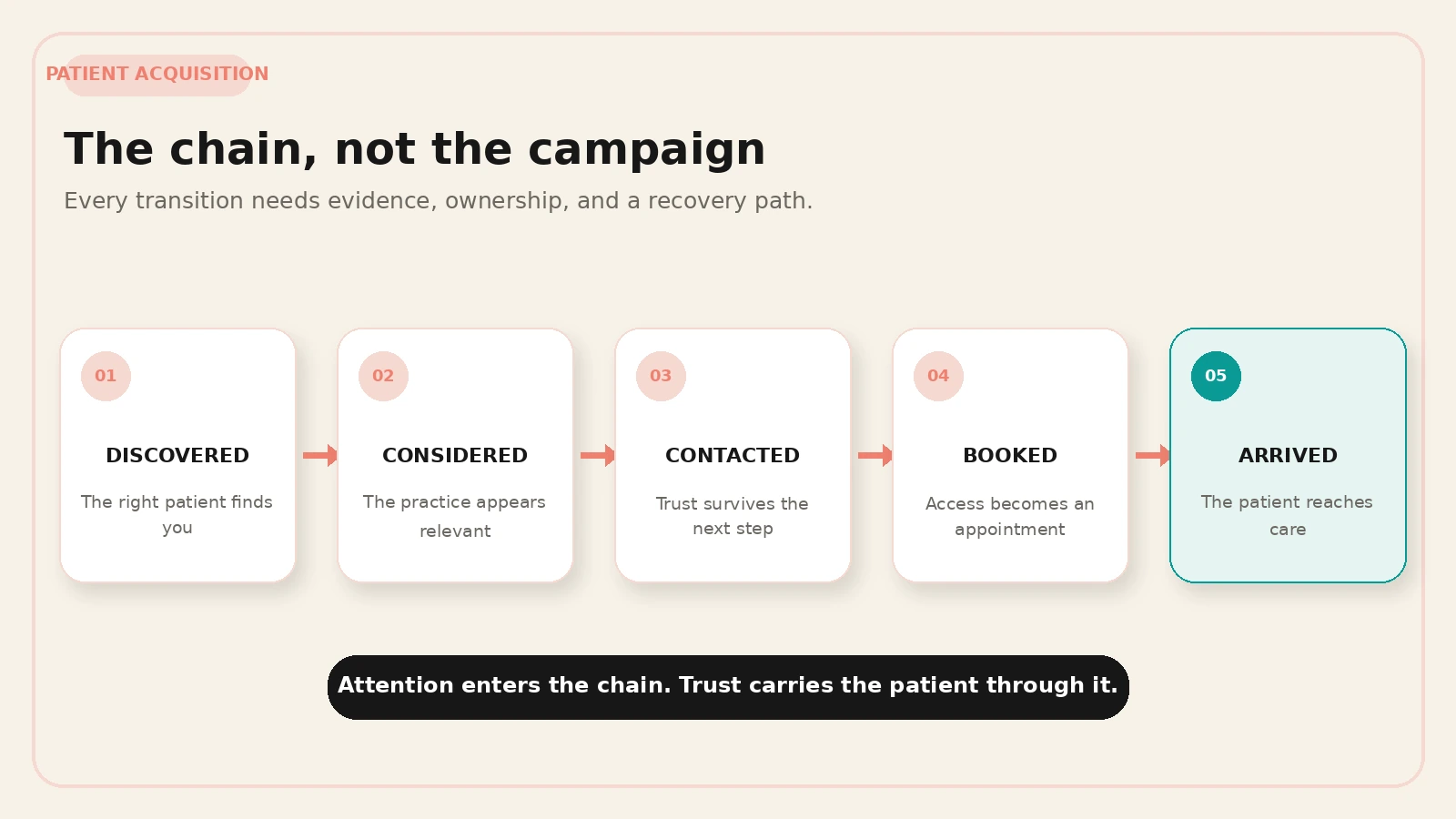
Each arrow hides a different kind of work.
Discovered to considered depends on relevance. Did the patient find a practice that appears to treat the actual problem, in a location and manner that could work?
Considered to contacted depends on trust and clarity. Did the available evidence make taking the next step feel sensible?
Contacted to booked depends on access. Did someone answer, return the call, explain the requirements, and offer an appropriate appointment?
Booked to arrived depends on preparation and confidence. Did the patient understand where to go, what to bring, what it may cost, what forms to complete, and what to do if plans changed?
Practices often measure the first state because platforms make it easy. Impressions rise. Traffic rises. Calls rise. Everybody admires the top of the chain while the middle remains a dark hallway.
Do not ask only how many people entered. Ask where movement stopped.
If local search produces qualified calls but few bookings, the acquisition channel may be working while the booking process fails. If referrals are plentiful but patients arrive without required records, the handoff may be incomplete. If appointments are booked and then abandoned, the gap may involve wait time, reminders, transportation, cost uncertainty, preparation, or a competing office that offered care sooner.
Give every transition an owner, a fact that proves movement, and a recovery path when movement stalls. Without those three things, the strategy is a drawing.
Trust is the first conversion event
The word conversion can make a patient sound like raw material moving through machinery. Keep the metric if it helps. Lose the mentality.
The first meaningful change is not from visitor to form submission. It is from uncertainty to enough trust to continue.
That trust does not come from saying “trust us.” It comes from reducing specific doubt.
A useful service page answers the questions a suitable patient is trying to carry:
- Is this the kind of problem you handle?
- Which clinician would I see?
- What happens during the first appointment?
- Do I need a referral, test, or record first?
- What does the next step look like?
- What might prevent me from booking here?
- How can I ask a question without surrendering my entire medical history to a generic form?
A credible doctor biography does more than stack degrees. It connects training and experience to the work the physician actually performs. It sounds like a person without manufacturing intimacy. It gives the patient a reason to believe there is competence behind the door.
Reviews can contribute another imperfect signal. A 2022 systematic review indexed by the National Library of Medicine examined whether online patient reviews were associated with healthcare outcomes. It found consistent positive correlations with patient experience, while associations with quality measures were mixed. Online reviews should not be treated as a clinical-quality instrument. Their practical role in acquisition is narrower: patients encounter them while evaluating care, so practices should understand and respond to the experience evidence they contain without pretending star ratings are medicine. Review the systematic review abstract.
Trust also breaks through inconsistency. A directory says one phone number. Google lists another. The website names a physician who left eight months ago. One page says referrals are required; the booking form lets anyone continue. The practice may see content maintenance. The patient sees risk.
Before buying attention, run the clinic website trust signals review and inspect the path as a new patient would. Search the practice name. Open the physician profile. Check the service page. Call the number. Submit the form. Read the confirmation. Follow the directions.
Trust is not a brand adjective.
It is what remains after the path survives inspection.
Choose channels by how care is sought
There is no best acquisition channel for healthcare. There is only a channel that fits the way a particular kind of care is sought.
A patient looking for urgent, local relief behaves differently from someone choosing an elective specialist after weeks of research. A parent follows a different trust path than an employer arranging occupational health services. A high-acuity referral should not be designed like a cosmetic consultation. A rural practice does not inherit the same geography as a clinic surrounded by ten competitors.
Choose channels by answering four questions.
Where does the decision begin?
It may begin with a referring clinician, an insurance directory, a family recommendation, a local search, a condition-specific search, a community organization, or an established patient asking about another service.
Start where real decisions already begin. Do not force every specialty into social media because the audience is theoretically present.
How much trust exists before the patient finds you?
A physician referral transfers some trust. A search result transfers almost none. A recommendation from a treated family member carries a different kind. The less trust the source transfers, the more evidence the practice must provide before asking for commitment.
How urgent is the need?
Urgency changes tolerance. A person in pain may value immediate access and a direct answer. A patient considering a complex procedure may need time, detailed evidence, a second opinion, and clarity about the care pathway.
Can the practice absorb the demand?
Do not accelerate a channel that produces appointment types with no near-term capacity. Do not court referrals if the receiving process cannot acknowledge, schedule, and close them. Our referral management guide covers the last-mile states that generic acquisition plans usually ignore.
Select one or two channels where fit, trust, and capacity align. Then make the handoff excellent. A modest referral network with reliable closure can outperform a loud campaign pointed at an unprepared desk.
The front desk is part of the strategy
The patient has found the practice. Read the reviews. Checked the insurance page. Opened the doctor’s biography. Worked up the nerve to call.
Then the phone rings six times.
This is where a six-month strategy can die in forty seconds.
The front desk is often blamed for failures designed elsewhere. Staff are asked to answer calls, greet patients, verify coverage, handle records, manage exceptions, watch several queues, and translate vague marketing promises into real appointments. If the website says “Book now” but no appointment type matches the request, the desk inherits the contradiction. If a campaign promotes a service with no capacity, the desk becomes the apology department.
Treat contact handling as part of acquisition design:
- Define which requests the front desk can book directly.
- Define which need clinical review, referral validation, authorization, records, or other prerequisites.
- Give staff plain-language explanations for common next steps.
- Set an owned process for missed calls, voicemails, forms, and portal requests.
- Record why appropriate patients could not book.
- Provide a safe route for urgent concerns according to approved policy.
- Give unsuitable patients a respectful disposition rather than a dead end.
Do not write a script that turns people into robots. Give staff a structure: acknowledge the request, establish the next relevant fact, explain what happens next, confirm ownership, and state when the patient should expect an update.
If online scheduling is appropriate, test more than whether the calendar loads. Test whether a new patient can choose the correct visit, understand eligibility, recover from uncertainty, and receive confirmation. The patient selfscheduling guide explains why a visible slot is not the same as safe, usable access.
The handoff from marketing to operations should not exist.
It should be one system.
Measure arrivals, not applause
A practice does not need a cathedral of dashboards. It needs a small chain of trustworthy facts.
Track, at minimum:
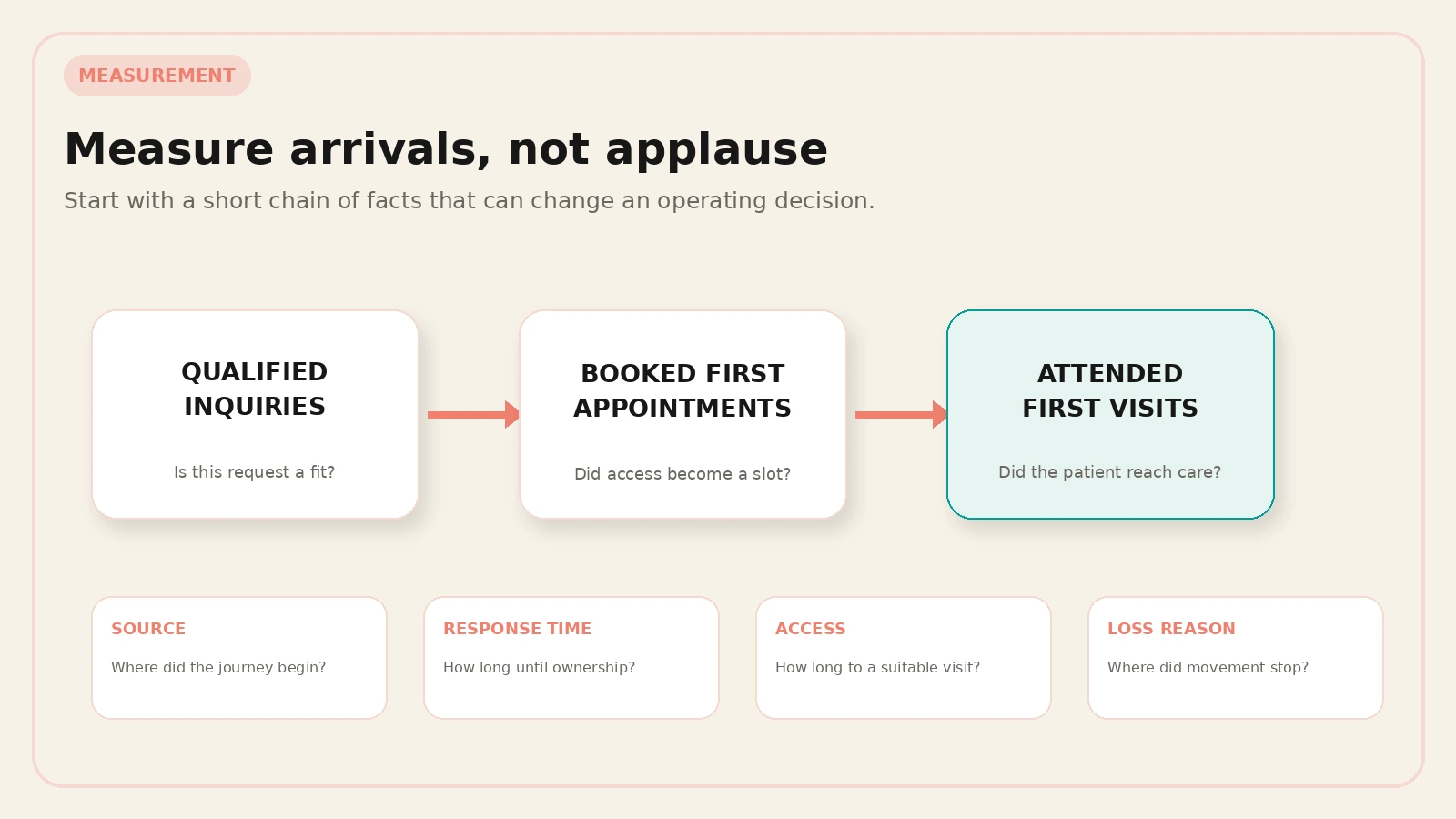
- Qualified inquiries: Requests that appear to fit the defined service boundary.
- Booked first appointments: Qualified inquiries that receive an appointment.
- Attended first appointments: New patients who actually arrive or complete the approved first encounter.
- Acquisition source: The source with enough specificity to support a decision.
- Time to first response: Measured consistently from a defined inquiry event.
- Time to suitable appointment: Not merely the earliest empty slot.
- Reasons qualified patients do not book or arrive: Using a short, governed set of operational reasons.
- Acquisition cost: Where spend exists, divided by attended first visits—not impressions, clicks, or raw form fills.
Be precise about denominators. A channel with 100 inquiries and 20 attended visits is not automatically better than one with 30 inquiries and 18 attended visits. Volume, fit, capacity, cost, clinical appropriateness, and downstream value may all change the decision. Do not collapse them into one magic score.
MGMA published a 2023 poll of 449 applicable medical-group respondents in which 54% reported tracking where or how they acquired new patients, 42% did not, and 4% were unsure. It was a voluntary MGMA Stat poll, not a census of all practices. Its sharper observation is operational: tracking the source alone is not enough; practices gain more useful information when they follow what happens after arrival. Read the MGMA analysis and methodology.
Keep collection simple enough that staff can do it accurately. A required dropdown with fifteen ambiguous sources will produce decorative data. Separate referring clinician from discovery source where both matter. Use unknown rather than forcing a lie. Review missingness. Listen to a sample of calls or inspect a sample of records under approved privacy and quality processes before trusting the report.
Most importantly, use the data to make a decision. If nobody can name what changes when a metric moves, stop collecting it.
The 90-day patient acquisition plan
You do not need to rebuild the practice in one Monday meeting. Work in sequence.
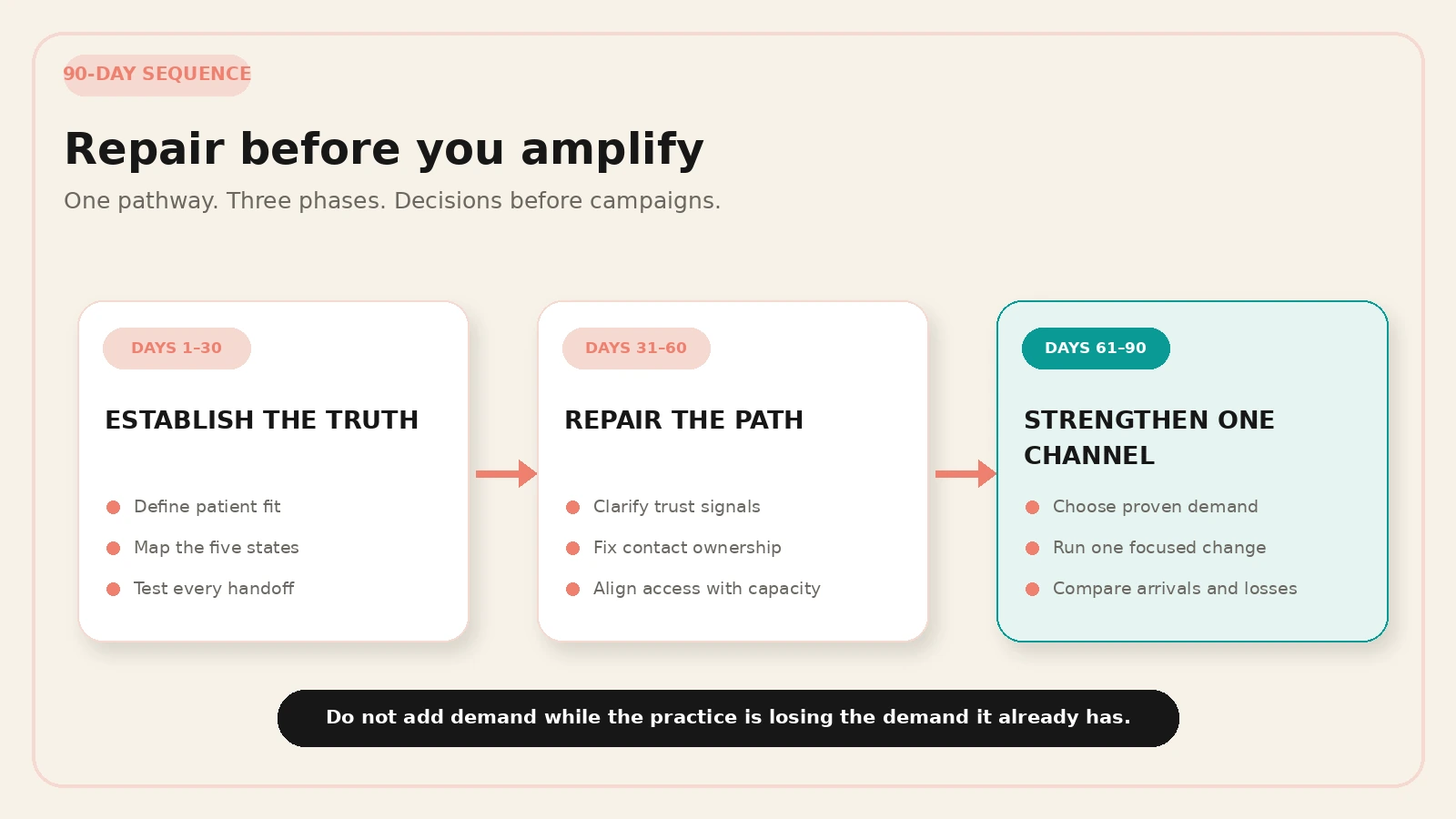
Days 1–30: establish the truth
Choose one service line or new-patient pathway. Define fit and capacity. Map the five states from discovery to arrival. List current sources. Sample recent inquiries and determine what happened to them. Test the website, phone, forms, directory listings, referral intake, confirmation, and first-visit preparation.
Do not begin by debating a new campaign. Find the break.
At the end of thirty days, the practice should know:
- which patients it is trying to acquire;
- where those patients currently come from;
- where appropriate demand is lost;
- which facts are measured reliably;
- which promise the outside world hears;
- whether operations can keep that promise.
Days 31–60: repair the path
Rewrite vague service pages. Correct inconsistent listings. Clarify the first visit. Repair missed-call ownership. Tighten form confirmation. Define booking and escalation rules. Align promoted services with real capacity. Improve the path from referral receipt to scheduled care.
This phase may feel unglamorous because it is.
A returned call does not win an award. It may win a patient.
Days 61–90: strengthen one channel
Choose the source that already shows fit or the channel with the clearest evidence of unmet demand. Improve one relationship, one local-search cluster, one condition pathway, or one community connection. Give it enough attention to learn from the result.
Do not launch five channels to avoid making one decision.
Compare qualified inquiries, bookings, arrivals, response time, and loss reasons before and after the change. If demand rises while arrivals do not, resist the urge to turn up the volume. Return to the broken transition.
The rule is simple: do not add demand while the practice is still losing the demand it already has.
Quiet practices can grow loudly
The strongest patient acquisition systems are often unimpressive from a distance.
A referring office receives an answer. A physician page explains the work without hiding behind credentials. A patient finds the correct phone number. A staff member returns the call when promised. The appointment is appropriate. The instructions make sense. The patient arrives knowing what happens next.
No fireworks.
Just trust surviving one handoff after another.
That is the difference between attention and acquisition. Attention notices the practice. Acquisition carries the right person into care.
If your practice has a dozen promotional activities but cannot show where appropriate patients disappear, do not add another channel yet. Map the chain. Repair the weakest transition. Make the promise clearer. Give the next action an owner.
Noise can make a practice visible.
Trust makes it chosen.
If the weak point is the digital path between discovery and booking, talk to Unnus about rebuilding it.