

Your reminder report says delivered. The empty appointment slot says something else. One is a communication event. The other is a systems problem waiting to be understood.
Most no-show strategies begin with an assumption disguised as a diagnosis: the patient forgot.
That assumption is convenient. It turns a complicated access problem into a messaging problem. Send a text. Add another touchpoint. Increase the cadence. Watch the delivery dashboard turn green.
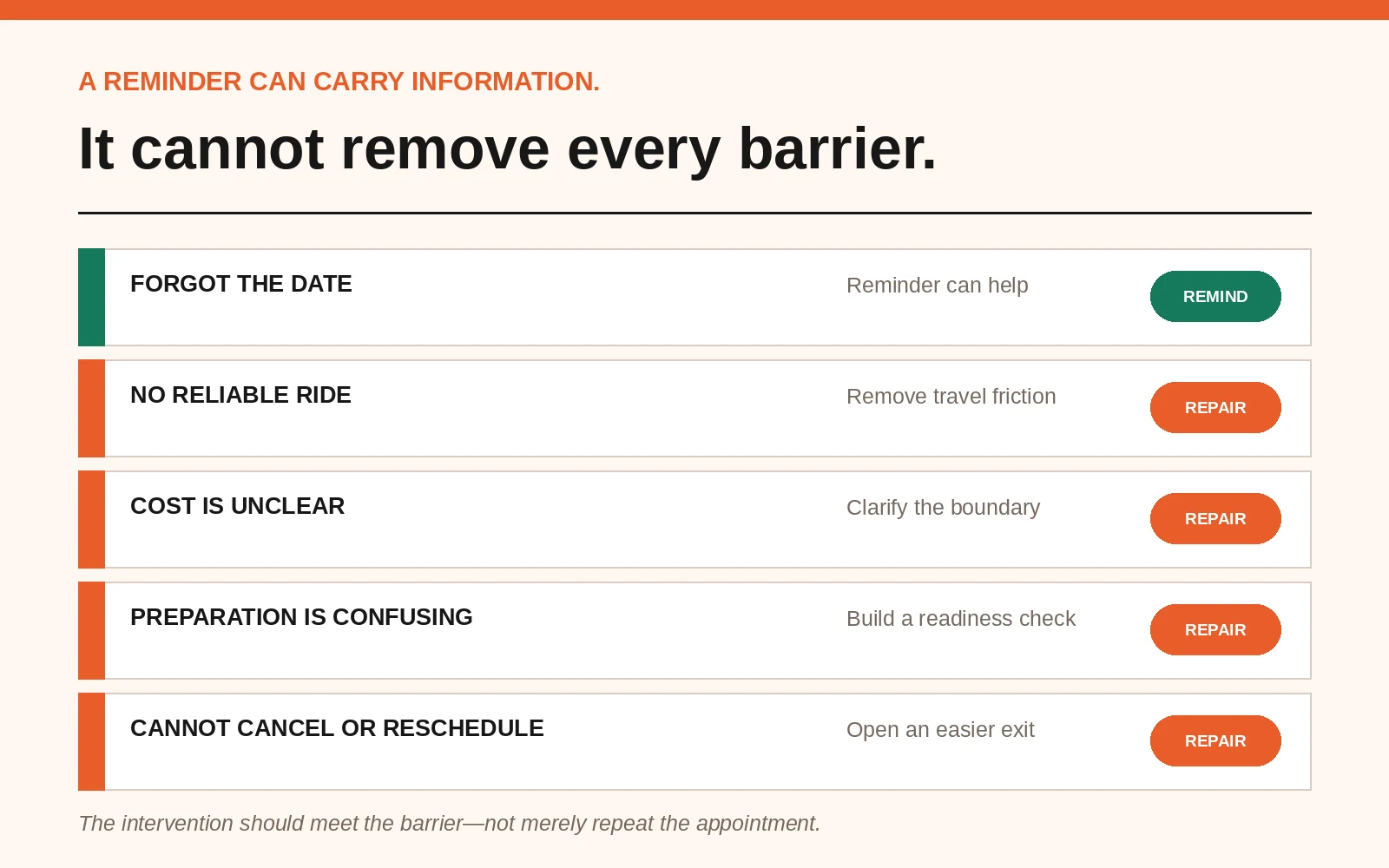
But delivery is not attendance. A patient can read every reminder and still have no reliable ride, no clear estimate, no way to leave work, no confidence they prepared correctly, or no usable route to cancel and reschedule.
When the only tool you reach for is another reminder, every missed appointment starts looking like forgetfulness—even when the system is what failed to make the visit possible.
This article will help you separate a forgotten visit from a blocked one, match the intervention to the evidence, and run one clean thirty-day attendance experiment. If your team is trying to reduce patient no shows, start by learning what happened after the slot was booked—not by scheduling another blast. You can also download the printable worksheet near the end. No patient names, phone numbers, diagnoses, or other identifying details belong in it.
Delivered is not the same as solved
Reminders work. That needs to be said plainly before we ask them to do less.
A 2026 systematic review and meta-analysis of ten randomized trials in hospital outpatient settings found that reminders improved attendance compared with no reminder. The pooled estimate was an 11% relative increase in attendance, with benefits reported for both SMS and telephone reminders. The studies were heterogeneous, so the result is not a promise that every clinic will gain eleven points. It is evidence that reminders deserve a place in the system. Read the review .
The mistake is not sending reminders. The mistake is treating reminder delivery as proof that the attendance problem has been addressed.
A delivered message tells you that a system handed data to a phone network or calling workflow. It does not tell you that the right person saw it, understood it, could act on it, or still had a workable path to the appointment. The phone may be shared. The number may be old. The message may be in the wrong language. The link may demand a portal password. The patient may read every word and still have no way to get there.
This is where dashboards flatter the operation. They measure the cleanest digital event and leave the difficult human part in the dark.
A no-show is an outcome, not a diagnosis
“No-show” is useful as an appointment status. It is dangerous as an explanation.
The label compresses many different events into the same square on the schedule: someone forgot; someone tried to cancel but could not reach the office; someone chose food or rent over an uncertain copay; someone’s bus did not arrive; someone felt better; someone became more frightened; someone was booked months ago at a time they never truly accepted; someone misunderstood the preparation and stayed home; someone believed the visit was virtual; someone went to the wrong location; someone’s child woke with a fever; someone died and the record did not know yet.
Those events do not share one cause. They should not inherit one remedy.
This does not mean patients have no responsibility. Appointments consume scarce time, and a missed visit can delay care for somebody else. But blame is a poor diagnostic instrument. It gives the clinic emotional closure without giving operations a next move.
The better question is not, “Why are these patients irresponsible?” It is, “What patterns appear before these missed visits, and which part of that pattern can we change?”
That wording matters. It moves the room from judgment to evidence.
What breaks after booking
The appointment was successfully scheduled. That only means the first transaction completed.
Between booking and arrival, the patient has to keep the date relevant, remember it, understand it, prepare for it, afford it, travel to it, and protect the time from everything else in life. They also need a dignified exit when the plan changes. Any weak link can turn a booked slot into an empty one.
Time gets stale
A visit booked three days away lives differently in the mind than one booked three months away. Jobs change. Symptoms change. Insurance changes. School calendars fill. The appointment becomes an old promise competing with newer emergencies.
A 2024 systematic review of open-access scheduling included sixteen studies. Ten reported a significant reduction in no-shows, while the others did not find a significant reduction or change. That mixed result is useful: shorter access can help, but it is not magic and must fit the clinic, population, and implementation. See the openaccess review .
If long lead time is concentrated in one visit type, sending more messages may be less useful than protecting nearer-term capacity, maintaining a waitlist, or allowing patients to pull the visit forward.
Preparation becomes a hidden test
“Arrive prepared” can conceal a small administrative obstacle course: fasting, medication questions, laboratory work, records, referrals, consent forms, a driver after sedation, insurance authorization, or arrival at a different building.
When instructions are dense, scattered, or delivered too late, the practice may record a no-show while the patient experiences a failed readiness process. A generic reminder that repeats the date and time does not answer, “Am I actually ready for this?”
The cost stays foggy
A patient can value the appointment and still hesitate when the financial boundary is unclear. Coverage may have changed. A deductible may reset. The office may say it cannot estimate the patient portion. The patient may avoid the conversation because asking feels embarrassing.
Silence should not be misread as indifference. If cost uncertainty clusters around a service, the intervention belongs earlier than the reminder: eligibility checks, plain-language estimate boundaries, financial-assistance routes, and a clear person to contact.
Life does not respect the appointment grid
Transportation, work, caregiving, disability access, weather, and acute illness do not become small because the clinic printed a policy. The calendar sees a fifteen-minute slot. The patient may see two buses, a supervisor, a wheelchair transfer, a child pickup, and half a day of lost wages.
The exit is harder than the entrance
Some systems make booking easy and cancellation humiliating. The reminder comes from a number that does not accept replies. The portal requires a password reset. The phone tree loops. The voicemail warns about fees before offering help. By the time a person can reach staff, the slot is too close to refill.
A timely cancellation is not failure. It is capacity returned while the practice can still use it.
Reminders help until they don’t
The useful reminder does more than announce a date. It helps the patient act.
At minimum, it should make the appointment identity, date, time, location or virtual route, preparation, and next step understandable. It should arrive through an appropriate channel and offer a realistic way to confirm, cancel, reschedule, or ask for help. For higher-preparation visits, a readiness check may matter more than another copy of the calendar entry.
The limits are equally important. A 2022 systematic review of SMS reminders across African settings identified barriers including literacy, confidentiality concerns, infrastructure limitations, rural residence, and loss of mobile phones. Its geography should not be generalized carelessly to every market, but the lesson travels: a channel can be technically available while remaining practically inaccessible. Read the systematic review .
Before adding another message, audit the current one:
- Does it identify the visit in language the patient recognizes?
- Does it distinguish the location from other facilities in the system?
- Does it explain the one or two preparation requirements that determine readiness?
- Can the patient reply or take action without calling during office hours?
- Is there a route for language, accessibility, transportation, cost, or preparation questions?
- Does cancellation release the slot quickly enough to reach the waitlist?
If the answer is no, frequency is not the first problem. Design is.
Different appointments carry different friction
A single practice-wide no-show rate can hide the only information worth acting on.
Separate the data by visit type, location, modality, lead-time band, day and time, and new versus established patient status. Where it is appropriate and ethically reviewed, examine whether the process is producing unequal friction across language, disability, geography, or other access-related groups. Do not use demographic data to punish or deprioritize patients. Use it to find where the system asks some people to climb a steeper hill.
The intervention should follow the appointment’s actual burden:
Routine follow-ups booked far out
- Question: Does attendance fall as lead time grows?
- Bounded test: Release a small block of nearer-term follow-up capacity.
Prep-heavy procedures
- Question: Are patients ready, not merely reminded?
- Bounded test: Add a two-way readiness check with a named escalation route.
Visits with frequent late cancellations
- Question: Is changing the appointment too difficult?
- Bounded test: Add one-step cancellation and release the slot to the waitlist immediately.
In-person follow-ups with travel friction
- Question: Is modality part of the barrier?
- Bounded test: Offer an eligible subgroup a virtual option and compare completion.
New-patient visits
- Question: Is uncertainty building before the first contact?
- Bounded test: Clarify cost, records, location, and what the first visit includes.
Recurring behavioral-health care
- Question: Is continuity fighting schedule variability?
- Bounded test: Try shorter booking cycles or a consistent recurring time.
Virtual care is a good example of why setting matters. A 2025 meta-analysis of forty-five retrospective cohorts estimated lower odds of non-attendance for virtual care than in-person care on average. But heterogeneity was extremely high, and the prediction interval crossed no effect. Virtual visits can remove travel while introducing device, connectivity, privacy, and digital-literacy friction. Read the metaanalysis .
Do not turn “telehealth reduced no-shows” into a universal policy. Ask which visits become genuinely easier when travel disappears—and which become harder when technology enters.
Match the intervention to the evidence
Practices often leap from a bad metric to a favorite tactic. No-shows went up, so buy more texts. Monday mornings look weak, so overbook them. A few people missed again, so tighten the fee policy.
That is action without diagnosis.
Start with evidence you already have: scheduling reports, lead time, cancellation timestamps, portal and phone failures, returned messages, readiness calls, waitlist fills, and de-identified reasons voluntarily offered during cancellation or follow-up. Talk to schedulers because they see the workarounds the dashboard does not. If you do not know why a pattern exists, admit it and run a short evidence-collection cycle before choosing the cure.
Then match one cause to one intervention:
- Likely forgetting: improve timing, clarity, channel preference, and confirmation.
- Long lead time: test nearer-term capacity, active waitlists, or pull-forward offers.
- Cancellation friction: enable a reply, link, or short route that releases the slot immediately.
- Preparation uncertainty: replace the generic reminder with a readiness sequence and help route.
- Transportation pressure: test earlier identification and approved support options where available.
- Cost uncertainty: move coverage and estimate communication earlier.
- Modality mismatch: offer an appropriate virtual or in-person alternative rather than forcing one format.
- Weak evidence: collect reasons neutrally before making a larger change.
Penalties deserve special caution. A fee may deter some missed visits, but it can also create avoidance, dissatisfaction, collection work, and inequitable pressure. Rules vary by payer and jurisdiction. Treat fees as a policy decision requiring legal, contractual, ethical, and operational review—not as a design shortcut.
Run one 30-day experiment
Changing reminders, fees, scheduling templates, confirmation timing, and waitlist rules in the same month may feel energetic. It also destroys your ability to learn.
Choose one comparable appointment group and one suspected barrier. Record a clean baseline. Change one meaningful part of the system. Keep the rest as stable as reasonably possible. Review attendance, cancellations, rescheduling, and reclaimed capacity every week. At day thirty, decide whether to keep, adjust, stop, or investigate further.
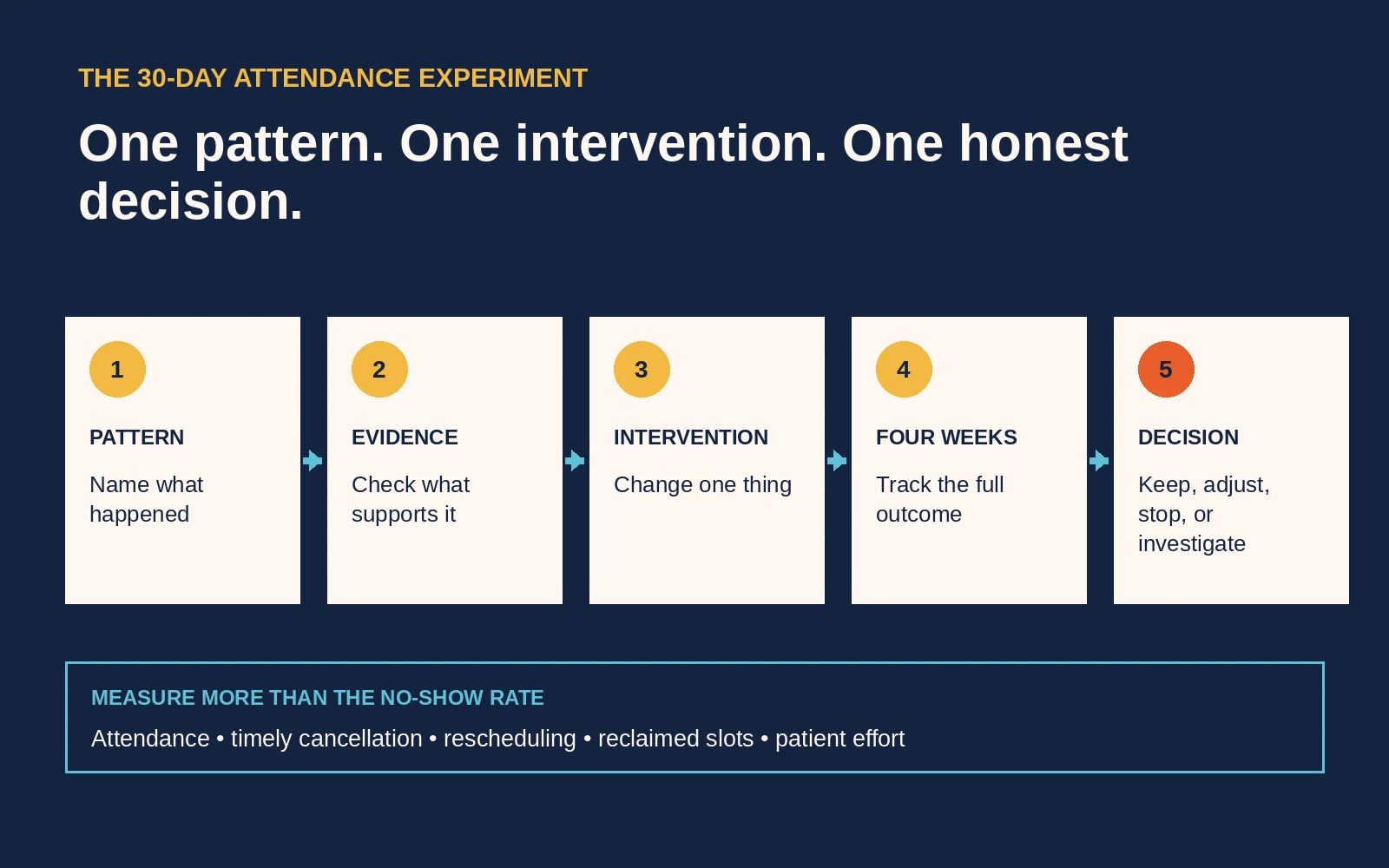
The unit of learning is not “our whole practice.” It might be established primary-care follow-ups booked more than thirty days out, or first-time imaging appointments that require preparation. A narrow test protects you from a dramatic conclusion built on incomparable visits.
Use these rules:
- Name the pattern without pretending to know the cause. “Tuesday afternoon follow-ups booked more than six weeks ahead have a higher no-show rate” is evidence. “Those patients do not care” is a story.
- Write the hypothesis before the change. State what you expect to improve and why.
- Choose one owner. A test owned by “the team” is usually owned by nobody.
- Count enough appointments to avoid worshipping noise. Five visits cannot establish a stable rate. If volume is low, run longer or combine only genuinely comparable appointments.
- Track side effects. Easier cancellation may initially raise cancellations while reducing no-shows and releasing slots earlier. That can be progress.
- Do not collect patient-identifiable details in the worksheet. Keep the analysis at the process and aggregate level.
Download the 30-day attendance experiment
The printable worksheet turns the method into a four-week operating rhythm. It includes a baseline, evidence check, intervention brief, weekly log, and final decision page.
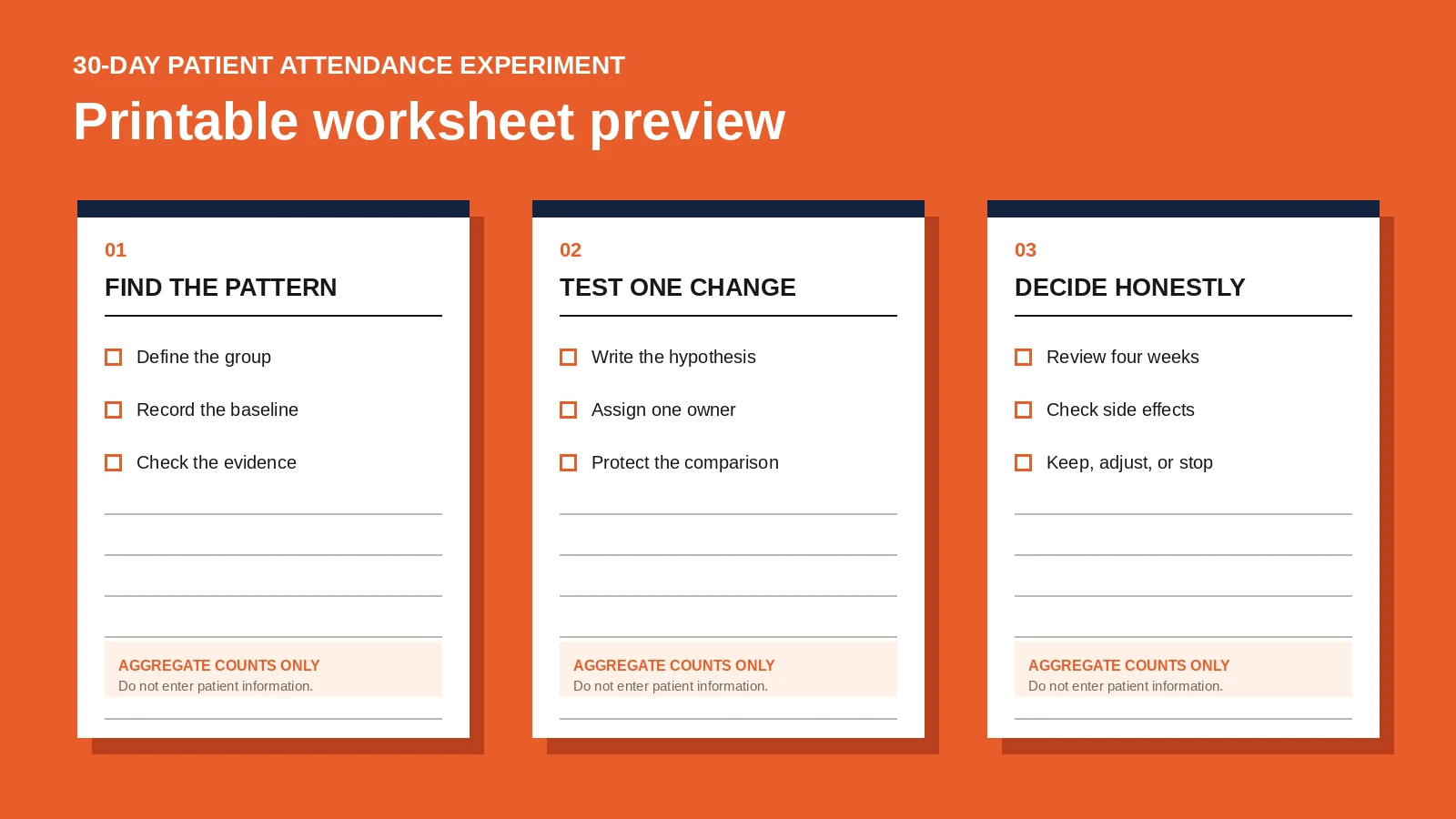
Get the five-page worksheet: Download the printable attendance experiment (PDF)
Use aggregate appointment counts only. Do not enter patient names, contact details, appointment reasons, diagnoses, insurance identifiers, or other protected information. The worksheet is an operational planning aid, not legal, clinical, statistical, or compliance advice.
Measure recovered access, not punishment
The no-show rate belongs on the page, but it should not be alone.
Track the full movement of capacity:
- Attendance rate: attended appointments divided by eligible booked appointments.
- No-show rate: missed appointments divided by eligible booked appointments, using one documented definition.
- Timely cancellation rate: appointments released early enough to be offered again.
- Rescheduling completion: cancelled appointments successfully moved when follow-up remained appropriate.
- Reclaimed-slot rate: released slots filled from a waitlist or other approved process.
- Lead time: days between booking and appointment, segmented rather than averaged into fog.
- Patient effort: calls, transfers, portal steps, or repeated contacts required to change the appointment.
Be careful with denominators. Decide how the practice treats same-day cancellations, clinician cancellations, duplicate bookings, walk-ins, and appointments moved by staff. Do not quietly change the definition after the intervention. A prettier number is not the same as a better system.
Also watch for harm. If attendance rises because patients feel threatened, confused, or unable to cancel, the metric improved while the experience worsened. If overbooking creates punishing waits when everybody arrives, one access problem was traded for another. Our guide to patient wait time deals with what happens when the schedule asks too much of the day.
For the booking side of the system, use the patient selfscheduling guide to test whether visit choices, availability, and exception paths make sense before the appointment is created. For the larger picture, patient journey mapping can expose the handoffs surrounding access, preparation, arrival, and follow-up.
Stop treating the empty slot like a moral failure
An empty appointment slot is expensive. It can interrupt continuity, waste scarce capacity, lengthen access for somebody else, and leave staff staring at time they cannot recover.
Take it seriously.
But seriousness is not the same as punishment. The strongest response is not another angry policy or another automated message stacked on top of the first two. It is the discipline to identify where the path broke, choose an intervention that can reach that break, and measure whether the change returned access without creating new harm.
Some patients forgot. Remind them well.
Some patients were blocked. Fix what blocked them.
And when the friction crosses your website, scheduler, forms, instructions, and patient communication, it is no longer a reminder problem. It is an experience-design problem. Contact Unnus if you want an outside team to help map it, strip out the dead ends, and make the next step easier to keep.