


A green “Sent” badge is one of the most comforting lies in healthcare operations. It proves that something left. It says almost nothing about whether care moved forward.
Referral management has a last-mile problem.
The order is visible. The destination is selected. The packet is assembled. A fax confirmation arrives or an electronic message changes state. The work feels clean enough to leave the screen.
Then the referral enters somebody else’s system.
It may be rejected because the specialist does not treat that condition. It may sit behind a missing record request nobody owns. The patient may never receive a call. An appointment may be scheduled and cancelled. The visit may happen while the consult note never returns. Weeks later, one system says sent, another says scheduled, a third says nothing, and a staff member keeps the real answer in a private list.
The referral did not disappear. Ownership did.
This article is a practical method for defining referral states, owners, exceptions, follow-up rules, and closure evidence. It is not a software ranking, a universal clinical protocol, or a patient-level tracking spreadsheet. The examples are fictional, and every interval or escalation rule must be approved for the referral type, urgency, specialty, organization, and applicable requirements.
The sent badge is where the trouble starts
Sending is an event. It is not an outcome.
A transmission receipt can prove that a fax machine accepted pages. An interface can prove that a message left one queue. Neither proves that the right specialist accepted the referral, that the patient obtained an appointment, that the service occurred, or that useful information returned to the referring team.
That distinction is old, durable, and still operationally expensive. The Institute for Healthcare Improvement’s 2017 guide describes ambulatory referral closure as a nine-step process rather than a single handoff. It begins with the decision to refer and continues through specialist review, appointment completion, communication back to the referring clinician, and discussion of the plan with the patient. The guide is not a current regulation or a universal workflow template. Its value is architectural: the loop has several actors and several places to fail. See IHI’s guide to closing the loop.
A CMS practice resource makes the same operational point more plainly. It recommends bidirectional communication, tracking referral requests through completion, communicating whether the receiving practice can schedule or accept the referral, and returning a clear response after the visit. Read the CMS practice resource.
The first repair is linguistic. Stop using sent as a synonym for managed.
If staff cannot say what must happen next, who is watching for it, and what evidence moves the referral forward, the system has recorded activity without creating control.
One referral can have five different truths
Imagine a fictional referral from a primary care practice to a cardiology office.
The referring EHR says sent because the packet left successfully. The cardiology fax queue says received because the document arrived. A scheduler’s note says left voicemail. The patient believes the referral is approved because somebody called. The clinician assumes the consultation is pending because no report has returned.
Every statement may be technically true.
Together, they still fail to answer the useful question: What has happened, and what must happen next?
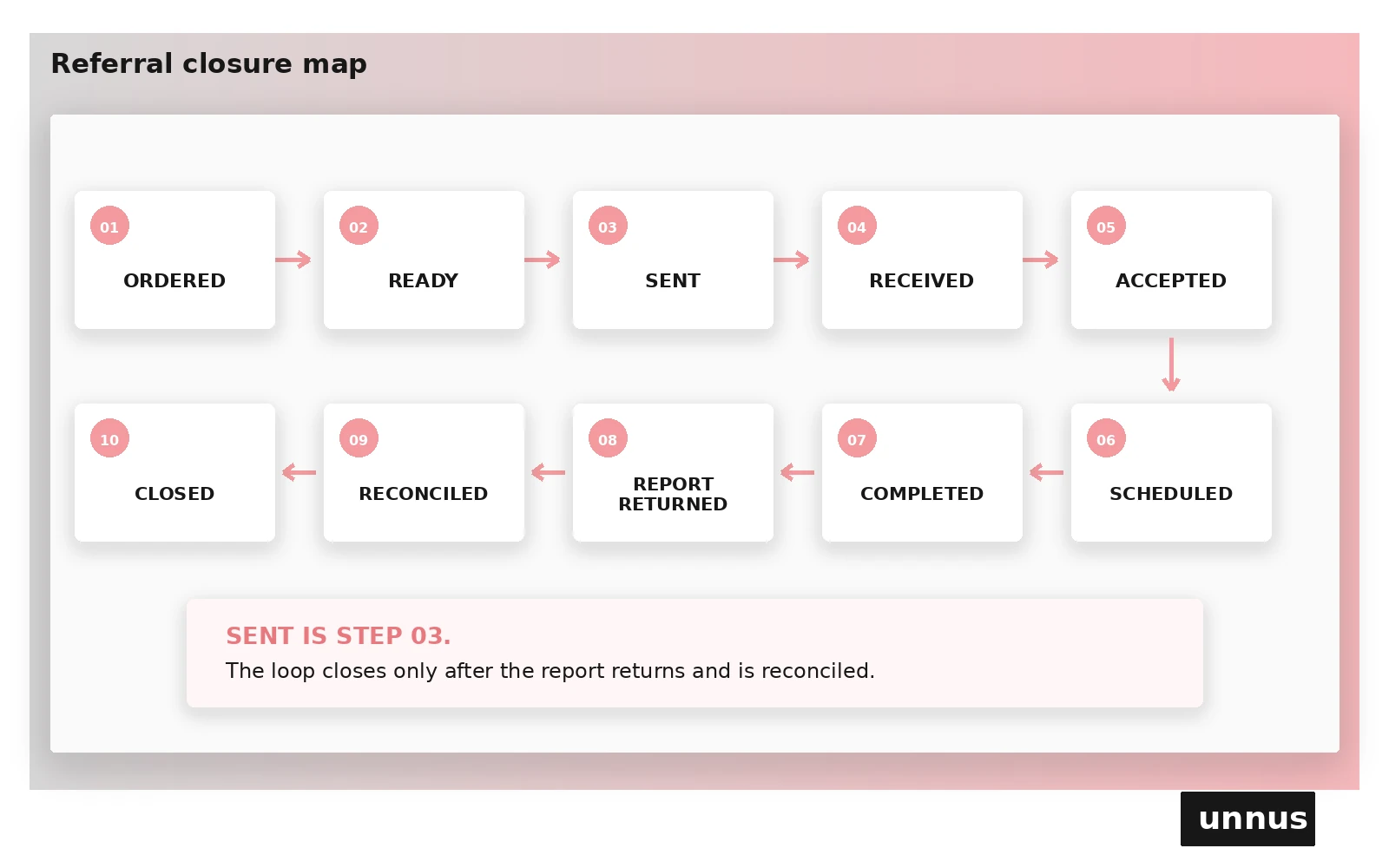
A workable model separates the referral into observable states:
- Ordered: A clinician has initiated the referral and stated its purpose and priority under local policy.
- Ready to send: Required information has been assembled and unresolved prerequisites have an owner.
- Sent: The referral has left through the intended channel, with transmission evidence where available.
- Received: The destination has acknowledged receipt—not merely the sending system.
- Accepted: The receiving service has agreed that it can act on the referral, or has provided a disposition.
- Scheduled: An appointment or service date is known, where scheduling is part of the pathway.
- Completed: The referred service is known to have occurred.
- Report returned: The requested result, consultation note, or disposition has reached the referring organization.
- Reconciled: The appropriate owner has reviewed and routed the returned information under the organization’s process.
- Closed: The locally defined closure evidence exists, including an approved reason when the pathway ends without a completed visit.
This is a conceptual architecture, not a demand that every organization install ten dropdown values. Some systems will combine states. Some referral types need additional authorization, triage, prerequisite, or care-transition states. Some pathways do not end with a traditional consult note.
What matters is that no label hides two different operational realities.
A referral waiting for specialist acceptance is not the same as one accepted but unscheduled. A completed visit with no returned information is not the same as a returned report awaiting review. If those conditions share one pending bucket, the queue cannot tell staff what work belongs there.
A status is a contract
A useful referral status is not a colored chip. It is a small operational contract.
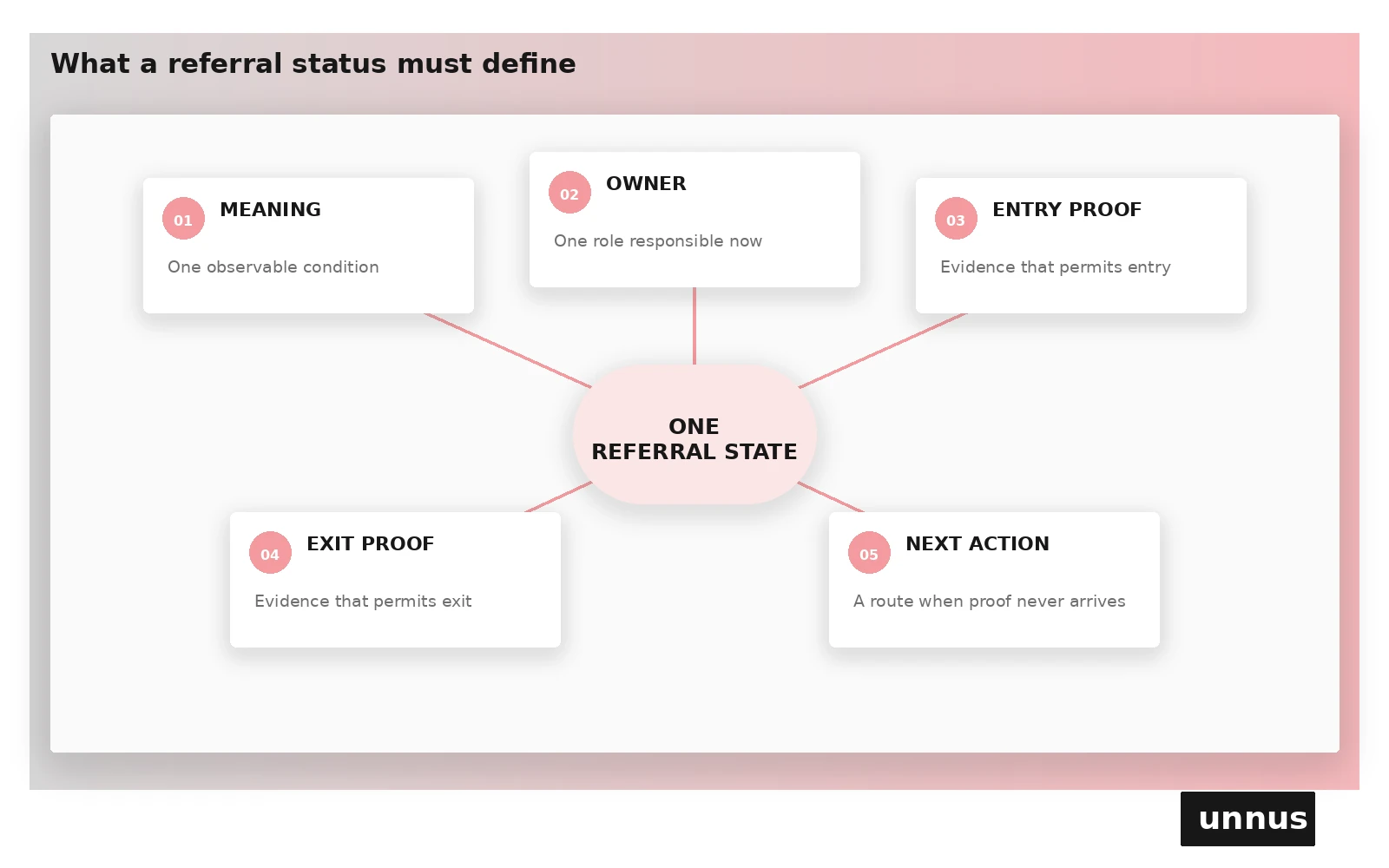
For every state, define five things:
- Meaning: What observable condition does this status represent?
- Owner: Which role is responsible while the referral remains here?
- Entry evidence: What fact allowed the referral to enter this state?
- Exit evidence: What fact moves it out?
- Next action: What happens when the expected evidence does not arrive?
Take received. If the system changes a referral to received when the fax transmission completes, the label describes the sender’s machine, not the receiving practice. If it changes only after a destination acknowledgement, the label carries a different and more useful fact.
Now take scheduled. Does it mean the specialist proposed a date, the patient accepted a date, or the appointment exists in a shared system? What happens if the date changes? Who records a cancellation? Can the state move backward without losing the history?
The label alone cannot answer any of this. The definition can.
This is why copying a vendor’s default statuses into an SOP rarely works. The software supplies nouns. The organization still has to define the evidence and labor underneath them.
The same rule applies when work crosses channels. A referral may begin in the EHR, leave by fax, receive an update by phone, and return as a portal document. The source of truth cannot be “wherever the last person looked.” Decide where the current state is maintained, how outside evidence enters it, and which record retains the history.
Build the state dictionary before the dashboard
Referral teams often begin with a report: everything older than a chosen number of days, everything missing a date, everything still marked open.
A report is useful only when its categories are trustworthy.
Start with a state dictionary. For each state, write a definition that another staff member can apply without guessing. Use fictional test cases to find disagreements before real referrals inherit them.
For example:
Pending
Reject this label unless it has a qualifier. Pending what—information, acceptance, authorization, patient response, appointment, service completion, or returned report?
Unable to contact
Define the approved contact process, the channels used, the documentation required, the next clinical or administrative owner, and the conditions under which this state can change. Do not let it become a quiet exit door.
Declined
Record the destination’s disposition and the next owner. A referral declined for missing information is different from one declined because the service is inappropriate, capacity is unavailable, coverage is not accepted, or another destination is recommended.
Closed
Require a closure reason and evidence. Completed with report returned is one reason. A clinician-approved alternative plan, patient decision documented through the appropriate process, duplicate order, or referral entered in error may be others. The organization—not a generic article—must determine legitimate reasons and review requirements.
The state dictionary should be short enough to use and strict enough to settle an argument. If two coordinators read the same fictional scenario and choose different statuses, the language is not finished.
Do this work before customizing a dashboard. Otherwise the dashboard will make ambiguity faster, brighter, and easier to export.
Exceptions are the workflow
The happy path is seductive:
Send → schedule → complete → receive report → close.
Real referral work lives in the verbs that interrupt it: reject, redirect, request, clarify, authorize, reschedule, cancel, retry, escalate.
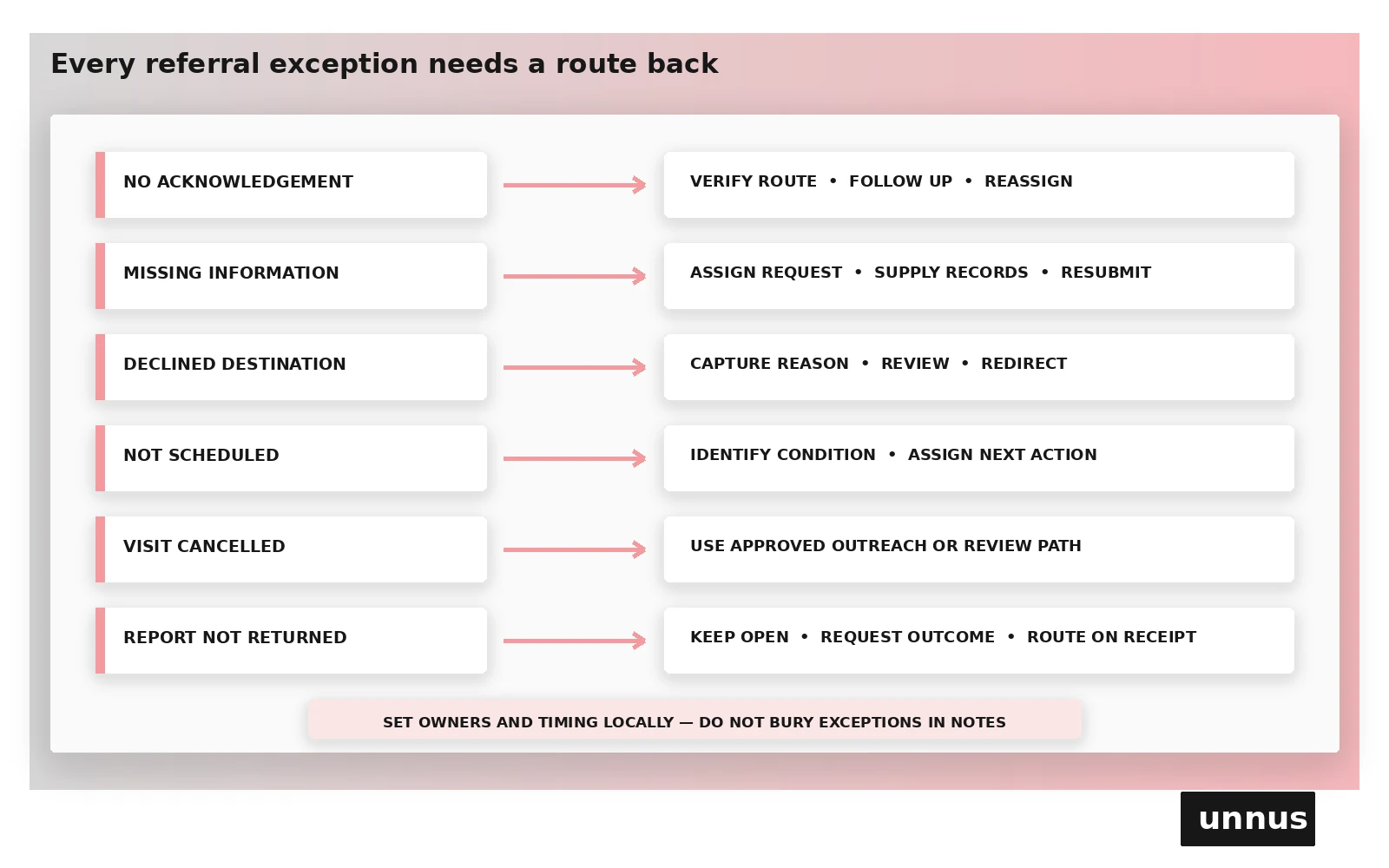
Treat each common exception as a designed route:
The destination does not acknowledge receipt
The owner needs an approved follow-up action, another communication route where appropriate, and a point at which the destination itself is questioned. Repeatedly resending the same packet is activity, not necessarily progress.
The receiving practice requests more information
The request needs a named internal owner and a visible return path. If it lands in a general inbox without changing the referral state, the referral looks active while the missing item ages elsewhere.
This is where referral management touches intake architecture without becoming the same job. Good patient intake design governs what information is collected and when. Referral readiness governs what a specific destination needs before it can accept and act.
The referral is declined or redirected
A rejection is a disposition, not closure by default. The referring team may need clinical review, another destination, revised information, authorization work, or communication with the patient. The next action depends on the reason.
The patient is not scheduled
Do not assume the cause. The destination may not have called. The patient may not have responded. The referral may be under review. Capacity may be unavailable. Authorization may be incomplete. The state should expose the known condition and the next owner rather than compress every cause into patient not scheduled.
When scheduling becomes the barrier, the design questions differ from the referral questions. Our guide to patient scheduling examines appointment rules, language, and recovery paths. Referral management must still retain ownership until the agreed scheduling evidence arrives.
The appointment is cancelled or missed
A cancellation or missed visit changes the referral path; it does not explain it. The locally approved process may involve rescheduling, outreach, clinician review, or another disposition. Our guide to reducing missed appointments explains why an absence should not automatically be diagnosed as forgetfulness.
The visit occurred but the report did not return
This is the last-mile failure many systems mistake for success. The patient reached specialty care, but the referring team still lacks the requested information. Appointment completion and report receipt must remain separate states if the organization needs to see and act on that gap.
A 2021 systems-engineering study of diagnostic referrals identified low-reliability workarounds and vulnerabilities across the process, then recommended human-factors approaches rather than treating referral failure as one bad click. It examined one academic medical center, so it should not be read as a universal map of every practice. Its durable lesson is that the weak points sit across people, tasks, technology, environment, and organization. Read the study summary.
Give time an owner
An aging referral is not a workflow until age changes what somebody does.
“Flag after seven days” sounds precise. It may still be meaningless. Seven days from the order, from readiness, from transmission, from acknowledgement, or from the requested appointment window? Seven calendar days or business days? Does the same interval make sense for every priority and referral type? Who receives the flag? What authority do they have?
Time rules need four parts:
- Clock start: The event that begins measurement.
- Interval: The locally approved period for this state and pathway.
- Owner: The role expected to review the exception.
- Action: The specific follow-up, escalation, or clinical review route.
Do not copy intervals from an internet checklist. Urgency, specialty access, authorization, local policy, clinical risk, contractual expectations, and regulation can change the appropriate response. The operational design should make approved rules executable; it should not invent them.
A useful queue answers more than What is old? It answers:
- Which expected event has not happened?
- How long has the referral been in this exact state?
- Who owns the next move?
- What was attempted?
- When does responsibility escalate?
- What evidence will resolve the exception?
Without those answers, staff sort the same red rows every morning and call it management.
Closed needs proof
Closing a referral is an information decision.
CMS’s 2026 electronic clinical quality measure CMS50—also listed as MIPS Quality ID #374—measures whether the referring clinician receives a report from the clinician to whom the patient was referred. That measure has defined eligibility and reporting rules; it is not a universal definition of operational closure. But it reinforces an important boundary: placing an order is different from receiving information back. Review the CMS measure specification.
For an organization’s workflow, closure evidence might include:
- the referral destination’s disposition;
- appointment completion evidence where applicable;
- the returned consult note, result, or outcome message;
- routing to the appropriate referring owner;
- review or reconciliation recorded under the organization’s process;
- an approved closure reason when the intended service did not occur;
- documentation of the next plan where required.
The exact set depends on the referral. A routine consultation, urgent diagnostic evaluation, therapy referral, imaging order, and community-service connection do not necessarily share one endpoint.
Do not force one closure definition across unlike work merely because the software has one Complete button.
Also separate operational closure from clinical responsibility. A referral coordinator can verify that evidence arrived and reached the correct queue. That does not mean the coordinator interprets clinical content or determines follow-up outside their role. The workflow should make that boundary visible.
A clean closed state should let an auditor reconstruct why the referral ended without reading somebody’s memory.
Test referral software with messy scenarios
A polished demo will show the happy path. Your acceptance test should not.
Use fictional records and ask the vendor or implementation team to demonstrate these scenarios from beginning to end:
1. The packet was sent but never acknowledged
Can staff distinguish transmission from receipt? Can they see the current owner and follow-up action without opening several screens?
2. The destination requests one missing document
Does the referral change state? Is the request assigned? Can the missing item return without creating a duplicate referral or erasing the original timeline?
3. The destination declines and recommends another service
Can the system preserve the disposition, route the decision to the appropriate owner, and keep the referral open until the next plan is resolved?
4. The appointment is scheduled, cancelled, and rescheduled
Does history survive every change? Can the queue distinguish a future appointment from a cancelled one without relying on free-text notes?
5. The visit is completed but no report returns
Can the system identify this exact condition? Can it trigger the approved follow-up without pretending the care loop is closed?
6. A report returns through another channel
Can staff attach or reference the evidence, route it correctly, and reconcile the state without maintaining a second shadow list?
7. The referral ends for an approved alternative reason
Can staff choose a specific closure reason, record required evidence, and prevent closed from becoming a garbage bin?
Then test reporting. Ask the system to show referrals by current state, time in state, owner, exception reason, destination, and closure reason. Confirm that each total can be traced back to the underlying referrals and definitions.
Do not upload real patient information into a sales demo, screenshot, design file, or informal testing environment. Use synthetic records and follow your organization’s privacy, security, contracting, and access-control processes for every real system.
The best vendor question is not Do you support closed-loop referrals?
It is Show us what your system does when the loop refuses to close.
Rebuild the last mile in one working session
You do not need to redesign every referral pathway at once.
Choose one bounded workflow: one referral type, one destination group, or one queue producing repeated status calls. Bring together the people who order, prepare, send, schedule, follow up, review returned information, configure the system, and handle common exceptions.
Then work through this sequence:
1. Name the current states
Export or write down every status, queue, flag, and private label currently used. Include unofficial terms staff rely on in spreadsheets, inbox folders, sticky notes, and conversation.
2. Run one fictional referral through the system
Move it from order to closure. Introduce a missing document, a declined destination, a cancellation, and a missing report. Record where ownership becomes vague or the official status stops matching reality.
3. Define “closed” first
State the evidence required for the chosen referral type, including approved alternative closure reasons. Working backward from closure prevents sent from becoming the finish line.
4. Write the state contracts
For every remaining state, define meaning, owner, entry evidence, exit evidence, and next action. Remove duplicate labels and split labels that hide materially different work.
5. Add clocks only where action follows
Choose locally approved intervals, clock starts, owners, and escalation actions. If nobody can say what happens when a timer expires, do not decorate the queue with another timer.
6. Test the ugly paths
Use the vendor scenarios above. Watch whether the workflow preserves history, exposes ownership, and returns exceptions to a resolvable state.
7. Retire one shadow system
Do not demand that staff abandon a spreadsheet before the replacement can answer the question the spreadsheet answers. Identify that question, build it into the governed workflow, validate it, and then retire the duplicate safely.
The output of the session should be small: a state dictionary, ownership map, exception matrix, closure definition, and list of configuration or vendor gaps. No patient data is needed to design any of them.
The loop closes when the information returns
Referral management fails quietly because every participant can complete a local task while the overall job remains unfinished.
The clinician places the order. Staff send the packet. The destination receives it. A scheduler leaves a message. The appointment occurs. A note is signed. Each person can truthfully say, My part is done.
The space between those completed parts is the last mile.
Design it explicitly. Give every state one meaning. Give every waiting period an owner. Give every exception somewhere to go. Keep completion separate from returned information. Make closed earn its name with evidence.
The goal is not a prettier referral dashboard. It is a system in which nobody has to search three inboxes, call two offices, and open a private spreadsheet to learn whether care moved forward.
If your referral journey crosses systems that cannot agree on what happened next, talk to Unnus. We help healthcare organizations turn fragmented operational steps into clearer digital services, workflows, and evidence.