Healthcare brands are now obsessed with patient acquisitions, ROI, revenues, and colorful charts. But if we’d like to build sustainable medical brands, we should reroute our attention to more dependable measurement units.
This article covers practical ways to measure healthcare brand equity—so you can track trust and attachment, not just short-term revenue.
Your revenue might not be the best metric to keep an eye on…
In the business world, often the focus is on yearly revenue or sales. Not only that, but marketers, to measure their marketing efforts, need to project the sales each quarter.
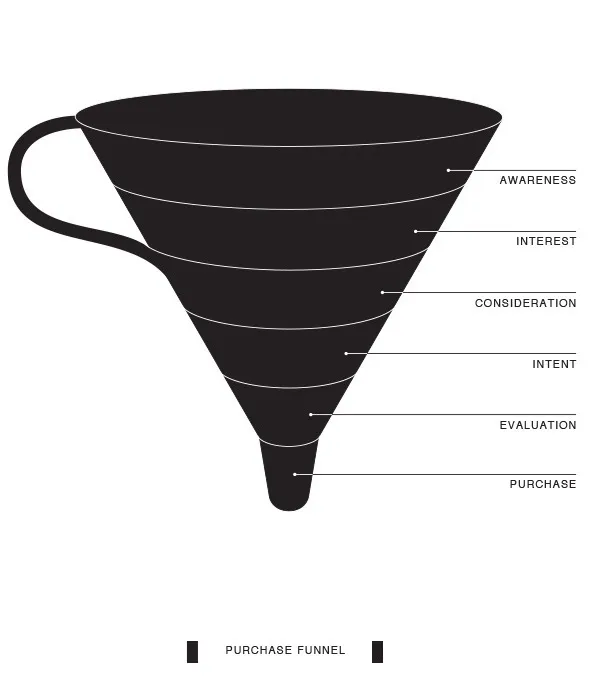
And to accomplish this, they use a model called the purchase funnel.
This model tracks sales by tracking customers as they move from awareness (being aware of your business) to interest to consideration to intent to evaluation and, finally, to purchase your service.
This model is only helpful if:
- Your main goal is to project revenue in the short term
- Patients move toward their purchase in predictable stages
- Current revenues are more important than brand- building
- Acquiring patient is more important than keeping them or;
- You have no use for non-customers.
There are a lot of ifs here, most of which no longer pans out.
So, instead of stuffing patients into funnels and squeezing the profit out of them, healthcare brands should encourage, empower, and delight their patients so they can build the brand.
NOTE: This is not to say that monthly or quarterly revenues are not important. But monthly and quarterly revenues are more sizable, more profitable, and more dependable when you focus on long-term relationships instead of short-term revenues.
Enters: The Brand Ladder
Because the objective of branding is to nurture and build relationships, it puts the emphasis where it belongs—on the patient.
Unlike the purchase funnel model, the Brand Ladder model aims to measure the success of the branding effort by tracking the patient attachment and loyalty to your brand. It offers a clear metric as to how your medical business is doing at each level.
This is the measurement layer of your overall healthcare branding .
Each rung of the ladder represents a satisfactory state of your patient with your brand. From patient satisfaction to delight, to engagement, and finally to empowerment. The object is to get as many customers as possible up the ladder to the top.

Here’s how it works:
#~First: The bottom rung represents patient satisfaction. This is where trust begins. The patient has tried your care service and found it to be as advertised.
While satisfaction is a good sign, studies have shown that satisfaction alone is not a reliable predictor of repurchase behavior or patient loyalty.
#~Second: The next rung-up is the patient delight. Here’s where trust catches fire. If you can surprise your patient with something more than baseline satisfaction, you’ll spark the kind of emotion that leads to loyalty.
This is the realm of great patient experience because delight is the leading cause of a patient’s “willingness to recommend.”
#~Third: One level higher is patient engagement. When a patient is truly engaged with a brand, he or she enrolls in the tribe. With membership comes increasing loyalty, escalating repurchase habits, and an emotional attachment that goes far beyond patronage.
This is where the brand becomes a building block in the patient’s identity, success, well-being, and even fulfillment.
#~Fourth: On the top rung is patient empowerment. This is the level at which patients incorporate your brand into the deepest part of their lives. They may depend on it for emotional support, social status, personal growth, or even business success.
They would no more switch to another brand than swap their right leg for a wooden peg. If you suddenly pulled your brand out from under them, they would collapse in a heap.
Empowered patients will move heaven and earth to ensure your success, happily attracting others to the tribe with their magnetic sense of commitment.
Measuring Branding with the Brand Commitment Scale (BCS)
The Brand Commitment Scale is an easy-to-use survey that yields a single number from 20–100. This score represents your overall progress up the brand ladder, where empowerment is given four times the weight of satisfaction.
If conducted annually, the BCS can highlight your gains (or losses), suggesting where you need more investment. It can also let you compare the scores at each rung of the ladder, and for each of the eight questions.

The power of this survey lies in its simplicity. All it takes is a service like SurveyMonkey or Typeform and a little of your patient’s time. A sample of 1,000 surveys should be enough for most medical businesses to get a useful reading.
What’s next?
If you’re investing in brand (strategy, positioning, voice, story, identity), you need measurement that reflects what branding actually changes: preference, trust, and loyalty.
If you want the full chain in order, here are the related reads:
- Medical branding strategy
- Healthcare brand positioning
- Humanizing healthcare brands
- Healthcare brand storytelling
- Medical brand identity design
Part 6 of 6: Healthcare Branding Series
You’re reading Part 6 of a 6‑part series on building a medical brand people trust (and choose).
If you want to keep the thread:
- Previous: Medical brand identity design
- Loop back: Medical branding strategy
- Or start a project: Contact